
A Jurassic reptile, 25 meters long
The pliosaurus in Pliosaurus is built from the anatomy of a real Jurassic sea reptile, with a skeleton, four rigid flippers, lungs and a way of swimming borrowed from living animals. It is also much bigger than any fossil found so far.
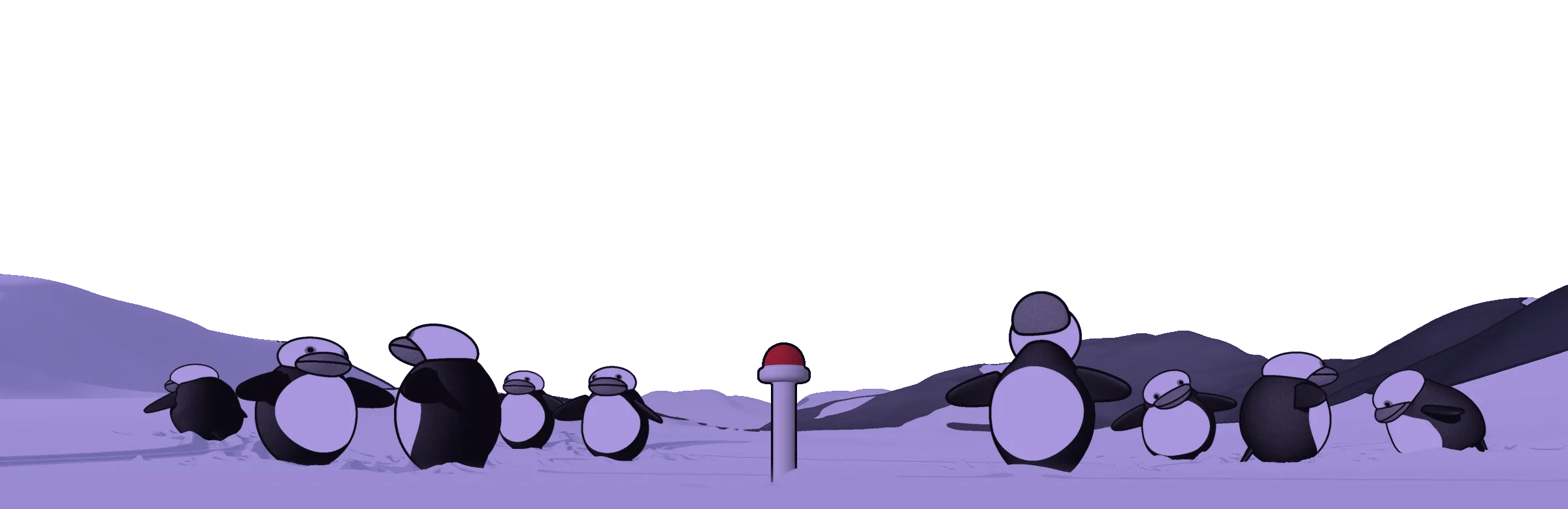
The pliosaurus in the series is 25 meters long. Put penguins shoulder to shoulder next to it, and you need about 50 of them to reach from its snout to the tip of its tail.
That size is invented for the series. The rest of the animal comes from a real sea reptile that lived in the Jurassic. This chapter shows what the real animal was, how the model is built from it, and how it moves on screen.
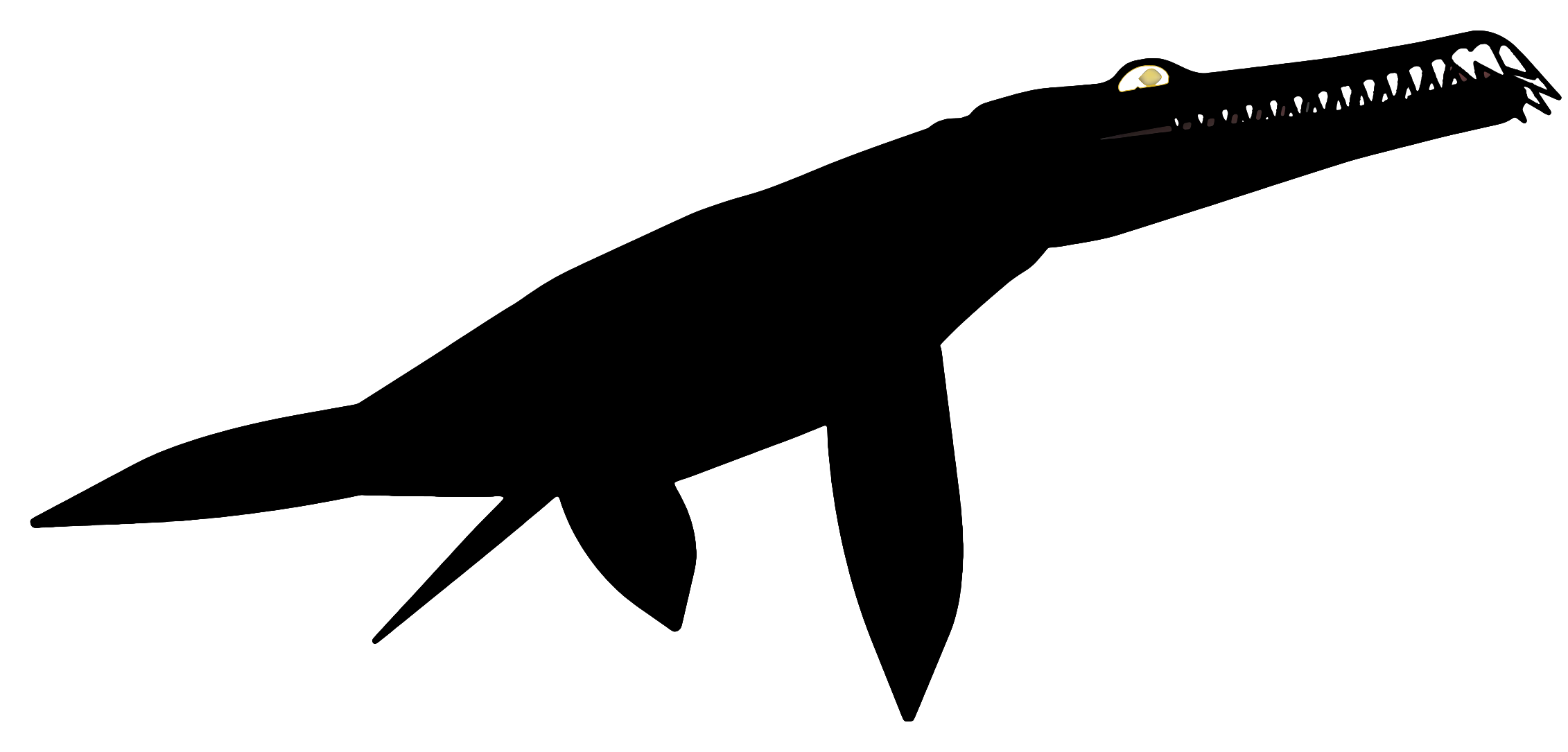
The pliosaurus with its jaws closed. Look at the long, slim snout and the four flippers, two at the shoulders and two at the hips.
A real reptile from the Jurassic
Pliosaurus was a marine reptile that lived from the Upper Jurassic to the Lower Cretaceous, about 154 to 137 million years ago. Its fossils come from Europe and South America (Wikipedia).
The largest known species reached around 10 meters and weighed nearly 11 tonnes. Their skulls were more than 2 meters long, and all four limbs were large flippers (Wikipedia).
Bigger than any fossil
The pliosaurus of the series is about two and a half times the 10 meters of the largest known species. It is that big because it has to lie under a whole colony of penguins and still look enormous.
The skull, the short neck, the trunk and the tail all grew by the same factor. So the animal keeps its shape, only larger.
A skeleton under one skin
The skeleton has a long skull, a short neck, a stiff trunk with ribs and belly ribs, three hip vertebrae and a tail of 32 vertebrae. One skin covers it all, made of oval sections along the spine. The spine runs high in the body, so the belly hangs below it.
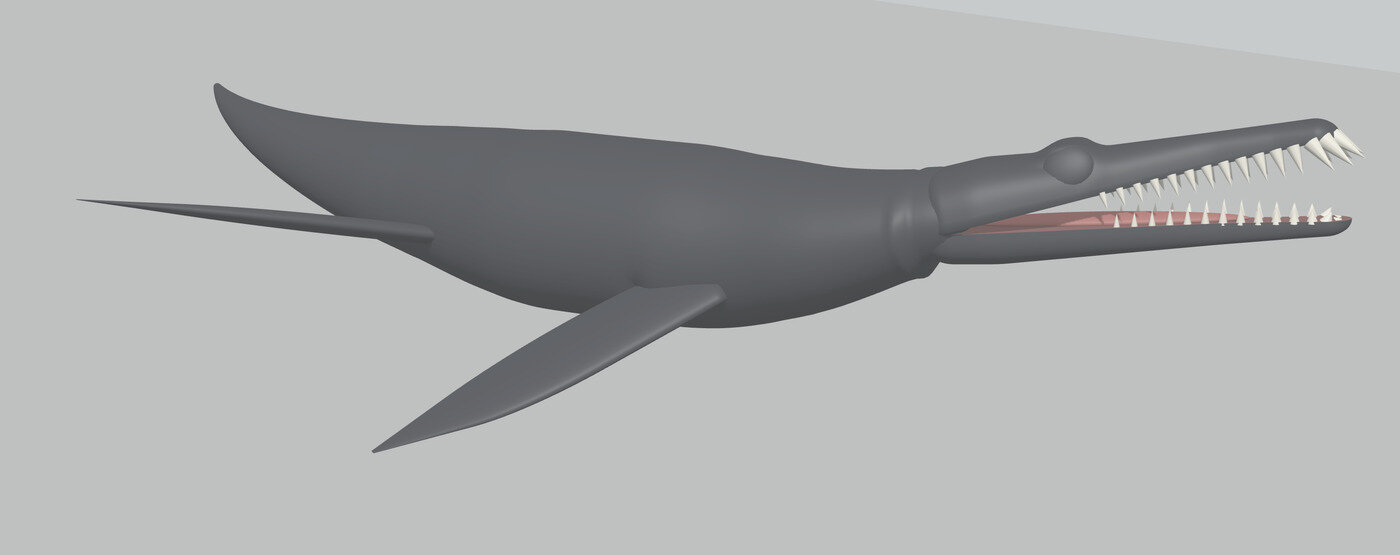
This is the 3D body of the pliosaurus, frozen in its block of ice. Look at the eye: it sits in a raised socket on the side of the head.
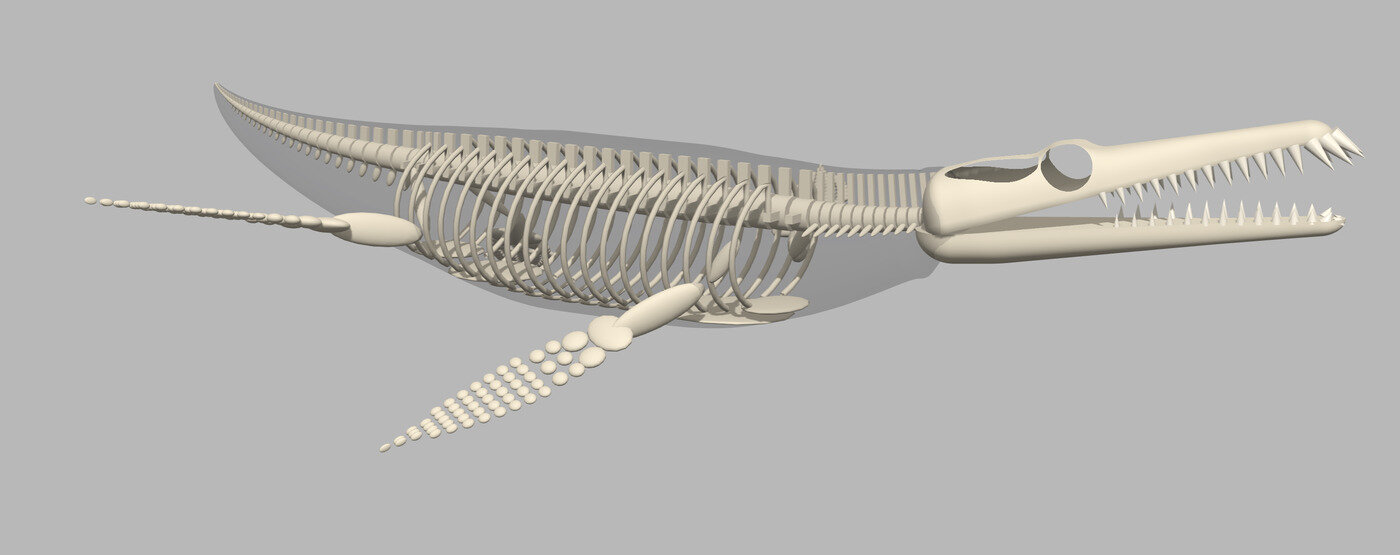
The skeleton. Look at the flipper: a row of small bones, fanning out to the tip.
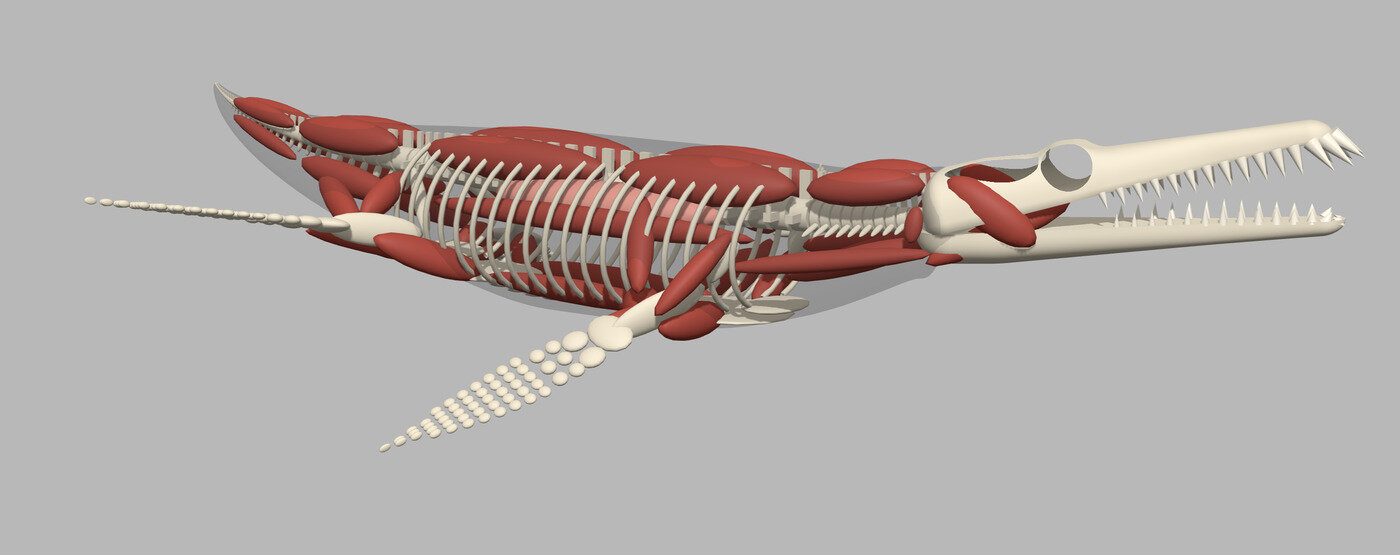
The muscles over the skeleton. Most of them sit along the back and at the base of the tail.
The trunk barely bends, the neck bends a little, and the tail bends the most. The skull, the jaw, the teeth and the flippers are rigid and never change shape.
A long head full of teeth
The skull of the model is a simplified version of the real one. It is broad at the back and narrows behind the eyes into a long, slim snout. At the tip the snout widens a little to hold the biggest teeth.
Each side of the upper jaw has 15 teeth, with three large fangs at the tip that point forward and out. Each side of the lower jaw has 14. When the jaw closes, every lower tooth ends inside the snout and never pokes through the upper jaw.
The eyes are invented for the series. They sit on the sides of the head like a crocodile’s, under a bony ledge, with a yellow iris and an upright slit for a pupil.
Lungs and a held breath
Like every reptile, the pliosaurus breathes air, so it has two long lungs high in its trunk. Under water it holds its breath with its lungs full, and the full lungs widen its trunk a little.
At the surface it breathes out in one fast burst and takes a quick, deep breath in. Then it holds its breath again.
Swimming like animals alive today
The real Pliosaurus swam with its flippers in a way called subaqueous flight, which means it beat them like wings under water (Wikipedia). Nobody has seen it swim, so its movements come from three living animals: the sea lion, the orca and the crocodile.
The front flippers stroke in three phases, the way a sea lion’s do. The hind flippers follow three quarters of a stroke behind them. In a turn the pliosaurus leads with its head and banks its body, as a sea lion does.
The pliosaurus cruising. Look at the hind flippers: they beat a little later than the front ones.
A wide turn. The head goes first, and the body tilts into the curve.
Its head stays steady while its body swims, as an orca’s does, and it spreads its flippers to brake. To bite, it snaps its head sideways and shakes it, as a crocodile does.
The lunge. The pliosaurus speeds up and opens its jaws wide to bite.
The same rules as the penguin
The pliosaurus follows the same method as the penguin. A pose is a short list of settings, one shared set of rules turns it into joint angles, and every frame runs through the rules for bones, soft tissue and contacts. A flipper or the lower jaw can press into the body, but never through it.
The same style filter draws it as a flat figure with outlines. Its body is a dark gray that the light shades, and its lines are a darker gray.