
The penguin's bones and habits
The penguin in Pliosaurus has a skeleton, soft tissue, lungs and habits taken from real penguins. This chapter shows each part of that body and how it shows up when the figure moves on screen.
When a penguin in Pliosaurus slides on its belly, the belly flattens against the ice and spreads a little to the sides. Nobody draws that. It happens because the figure has a soft body that rests on the ice under its own weight.
Every penguin on screen is a real penguin body fitted to Sander’s flat drawing. This chapter goes through that body part by part, from the bones to the habits, and shows where each part turns up in the animation.

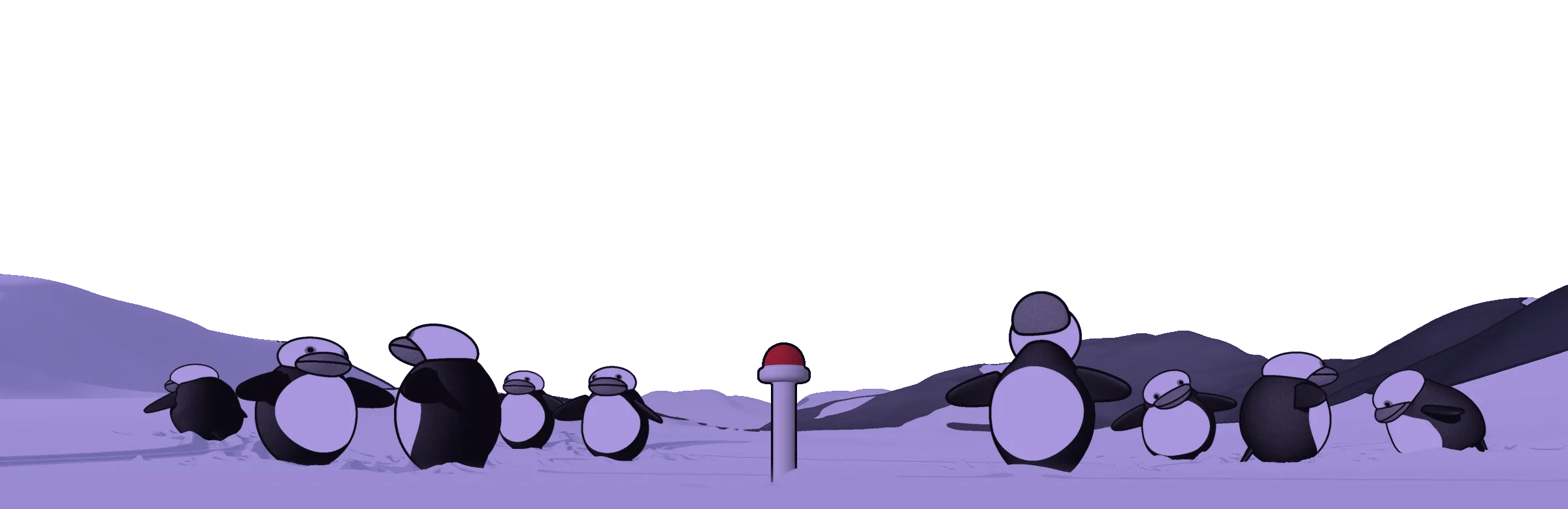
The penguin at rest. The round body, the white belly and the short flippers keep the shapes of the flat drawing.
A skeleton fitted to the drawing
The skeleton follows real penguin anatomy, scaled to the proportions of the drawing. It has a pelvis, a lower back, a ribcage with a keel at the front, a neck in four parts and a skull.
The legs sit inside the body, and only the feet show. When the penguin stands, its feet stay flat on the ice, and they move only when it takes a step. Its balance keeps the weight over the feet, so a penguin that leans forward shifts its hips back.

This is the 3D body before any drawing. The penguin holds its flippers out, so the shoulders are easy to see.
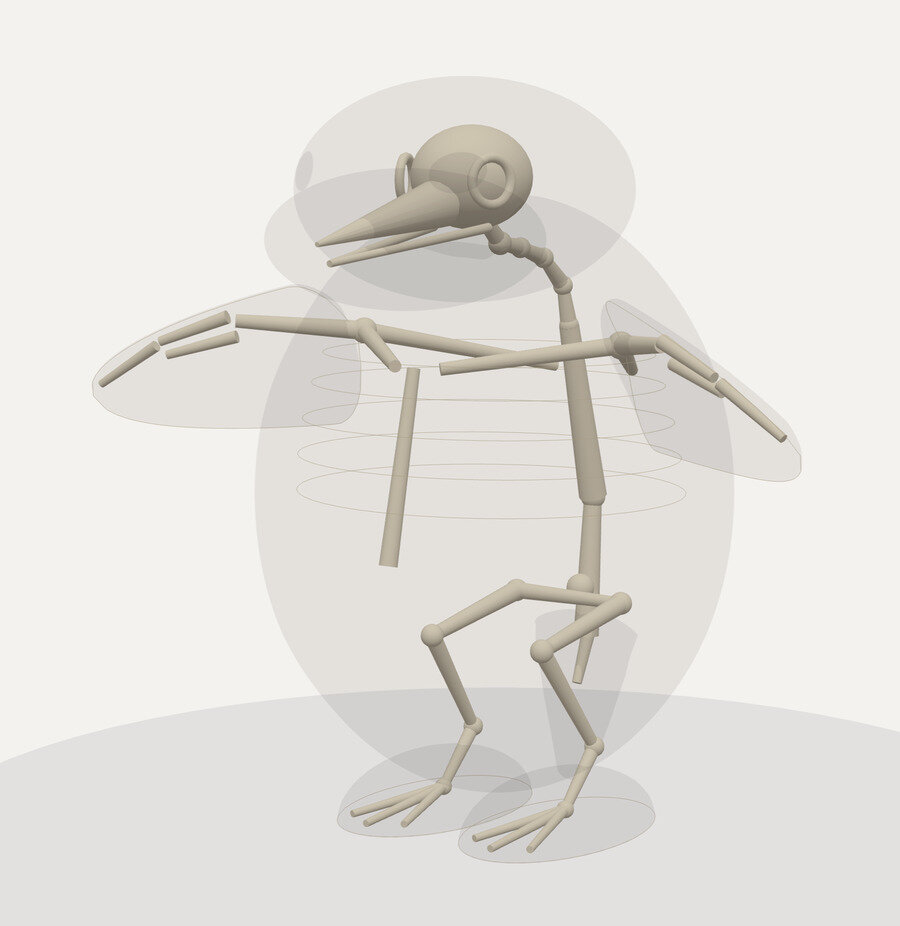
The skeleton inside the see-through body. Look at the legs: they bend inside the body, and only the feet come out.
Flippers that move only at the shoulder
A penguin’s wing is a flipper. Its bones are shorter and stouter than a flying bird’s, so they work as fins (Wikipedia).
In the animation model, each flipper is one stiff piece that turns only at the shoulder. It has no elbow or wrist that folds. The section is shaped like a wing: thick and round over the bones at the front edge, and thin at the back.
A flipper can press into the soft body, but it cannot pass through it. Before it would press too deep, it twists along its bone and lies flat against the body instead.
A soft body under thick skin
The body around the skeleton is a soft, heavy mass. Hard parts like the flippers and the beak can dent it, and the mass flows aside and keeps its volume. After a fast move it settles with a short delay.
One closed skin covers the whole body. It is thick, so it never shows creases. The white belly is only a color painted on that skin, which is why the drawing has no line where black meets white.
Lungs that breathe in every frame
The penguin has two lungs inside its ribcage. With every breath in, the lungs fill, the chest and belly push out, and the ribs swing a little wider.
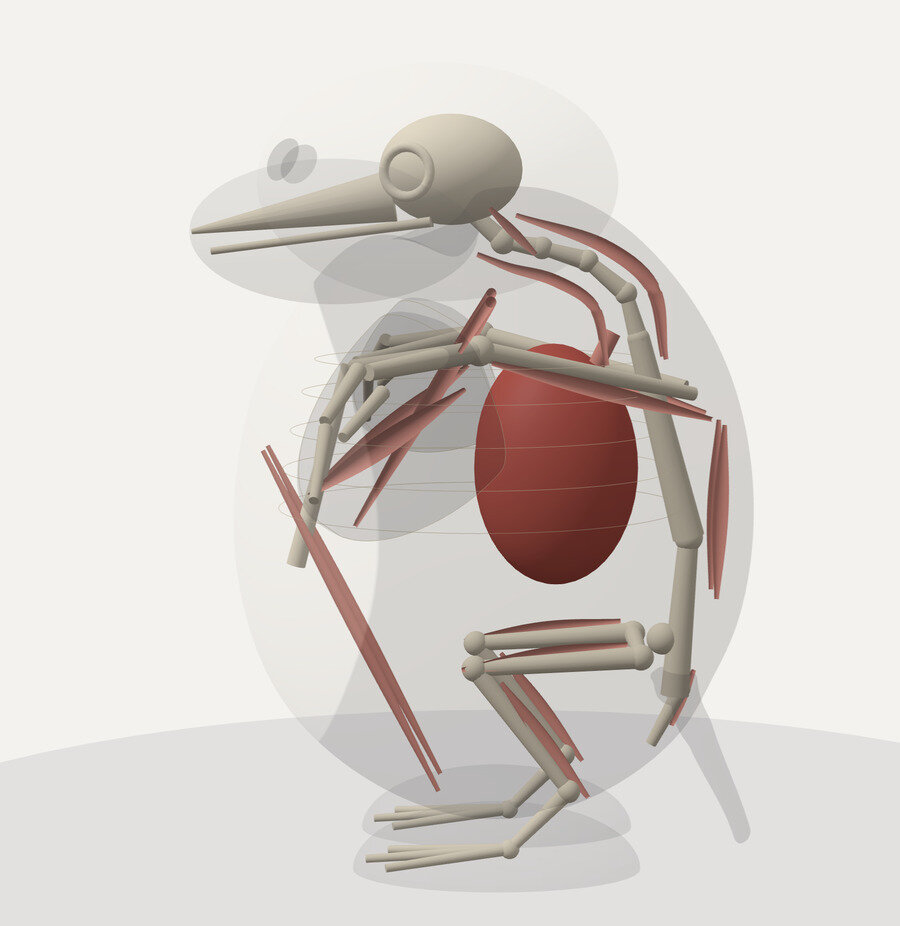
From the side, with one lung in red. The thin pink strands are muscles along the neck, the flippers and the legs.
Breathing runs in every scene, even when the penguin stands still. A calm penguin breathes evenly and lightly. After a climb or a fast walk it runs short of air, breathes deeper and faster, and pants with its beak open. A sleeping penguin breathes slowly and very deeply.
Habits from real penguins
Real penguins walk with a waddle, slide on their bellies across the snow, and use their tails to keep their balance on land (Wikipedia). The figure does all three.
The waddle. The body rocks from foot to foot, and each foot stays flat on the ice until it steps.
On a belly slide the whole body tips forward onto its belly, the legs trail behind, and the soft belly settles flat on the ice.
A belly slide, seen from the side. Look at the feet: they point back with the soles up.
The stiff tail feathers rest on the ice behind the heels when the penguin stands. When the penguin leans back, the tail swings up instead of passing through the ground.
The eyes blink as well. Most blinks come with a quick turn of the head, and a few come at random moments. A sleeping penguin keeps its eyes shut.
From habits to a pose
A pose is not a drawing of a penguin. It is a short list of body-language settings, such as energy, tension, where the penguin looks and how far it holds its flippers out.
One shared set of rules turns those settings into joint angles, and the skeleton and tissue rules check the result. A movement is a series of poses over time, and every frame of it runs through the same rules. The gaze leads, the body follows, and the flippers settle last.
A fall and a get-up. Nobody drew these frames. The same rules for bones and soft tissue ran on every one of them.
The body becomes a drawing again
A style filter draws the 3D body as a flat figure with outlines. It uses the flat colors of the drawing, one line width, soft shading and a little grain. The filter decides only how the figure looks, and it never changes the body underneath.
That body is the reason for all this work. Pliosaurus has 60 episodes of 60 seconds at 15 frames per second, about 54,000 frames in all. Sander designs the penguin and picks every look by eye. Claude Code, an AI coding assistant, helps write the code that turns those choices into moving figures.
The next time a penguin on screen takes a deep breath, look at its belly. It rises because the lungs inside it fill.